
 FIRST CHURCH OF CHRIST, LANCASTER, MA
 BACK TO RESULTS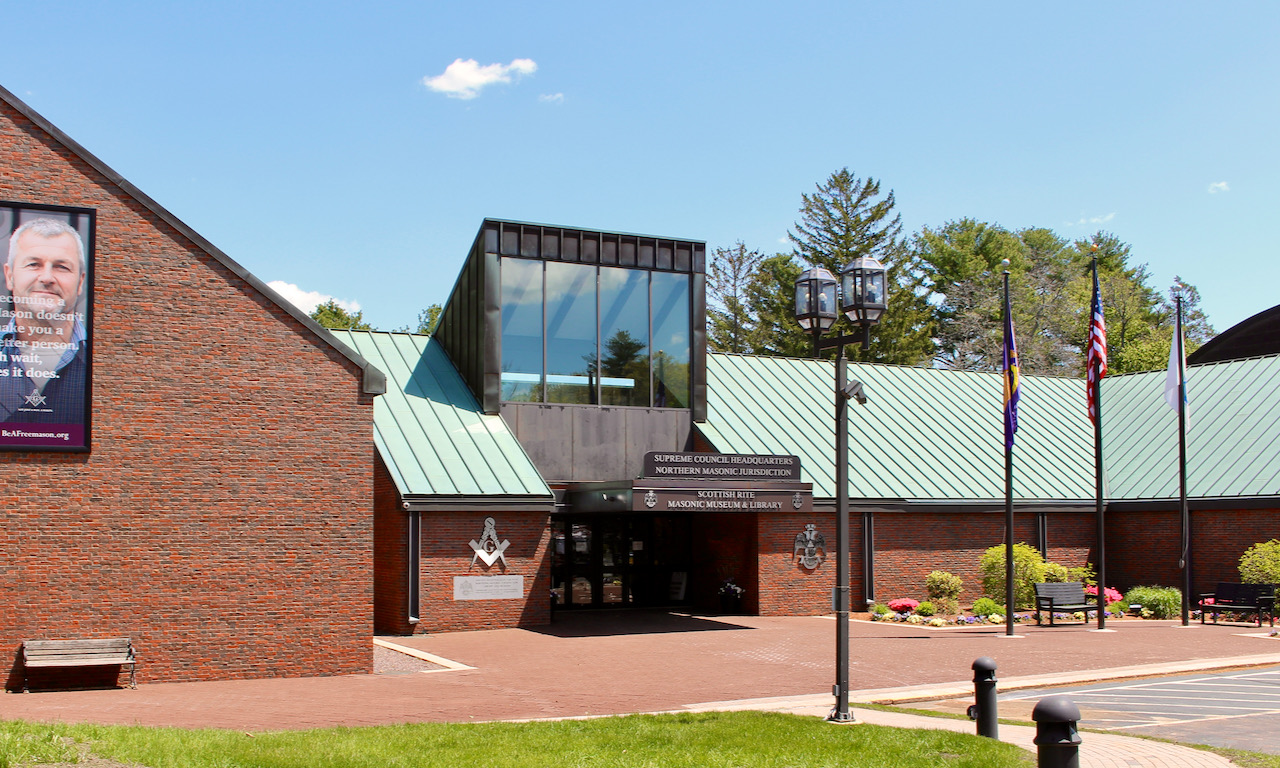
On April 20, 1975, nearly 200 years to the day since the earliest battles of the American Revolution occurred, the Scottish Rite Masonic Museum and Library was dedicated in Lexington, Massachusetts. Located along Massachusetts Avenue, the “Battle Road” on which British regulars marched on April 19, 1775, the museum, recognized at its founding as an official National Bicentennial Project by the American Revolution Bicentennial Commission marks the end of its 50th anniversary celebration on April 11, 2026.
The Scottish Rite Masonic Museum and Library is a unique institution that collects, interprets, preserves, and celebrates the story and history of Freemasonry and fraternalism within the context of American history. Described as a “historical society” of American Freemasonry, the Museum and Library pay special attention to the history of the Scottish Rite, founded in 1801, while serving the broader Masonic community.
While the origins of Freemasonry are obscure, the organization’s beginnings date to 1599 in Edinburgh, Scotland with the formal recording of an individual’s membership in a stone mason’s lodge. In 1721 The Constitutions of the Free-Masons by Scots Presbyterian minister James Anderson was published.
During the 18th century, Freemasonry became a popular and preeminent fraternal organization as lodges where political, commercial and intellectual elites met proliferated, supported by aristocratic and royal patronage. While the earliest records of Masonic Lodges in the United States are in Philadelphia, Boston’s St. John’s Lodge, constituted in 1732, remains the oldest in North America, .
Networks of Scots, English, and Irish Lodges provided important channels to support the British commercial empire in America. Colonists joined the Freemasons to stay connected with their British counterparts and while as an institution, Freemasonry remained politically neutral, the spread of the ideas and ideals behind the American Revolution within American lodges was inevitable. During the American Revolution Masons of note included George Washington, Benjamin Franklin, James Otis, and Paul Revere. The important role that Freemasons played in the founding of America was pivotal to the establishment of the Scottish Rite Masonic Museum and Library.
Today, the Museum maintains one of the largest collections of American fraternal and Masonic decorative arts including documents signed by early Massachusetts Masons such as Jeremy Gridley (1702-1767) and Paul Revere (1734-1818) and a portrait of Virginia Freemason George Washington (1732-1795) by Rembrandt Peale (1778 – 1860). Changing exhibitions explore topics related to Freemasonry, fraternalism, the Scottish Rite, and the history of our nation accompanied by lectures, gallery talks, workshops, symposia and other educational programs that foster a deeper appreciation of exhibitions and American and fraternal history. The Van Gorden-Williams Library & Archives has more than 60,000 books, 1,600 serial titles and 2,000 cubic feet of archival materials related to American history and fraternalism.
The Scottish Rite Masonic Museum & Library’s mission is to engage and inspire the public and members of the Masonic fraternity through its exhibitions, collections, publications, and programs. It aims to foster knowledge and appreciation of America’s past and culture, with a focus on United States history, Freemasonry, and fraternalism. It builds interest and support for its mission by emphasizing themes of patriotism, fraternalism, inclusion, and personal and civic virtues.