
 FIRST CHURCH OF CHRIST, LANCASTER, MA
 BACK TO RESULTS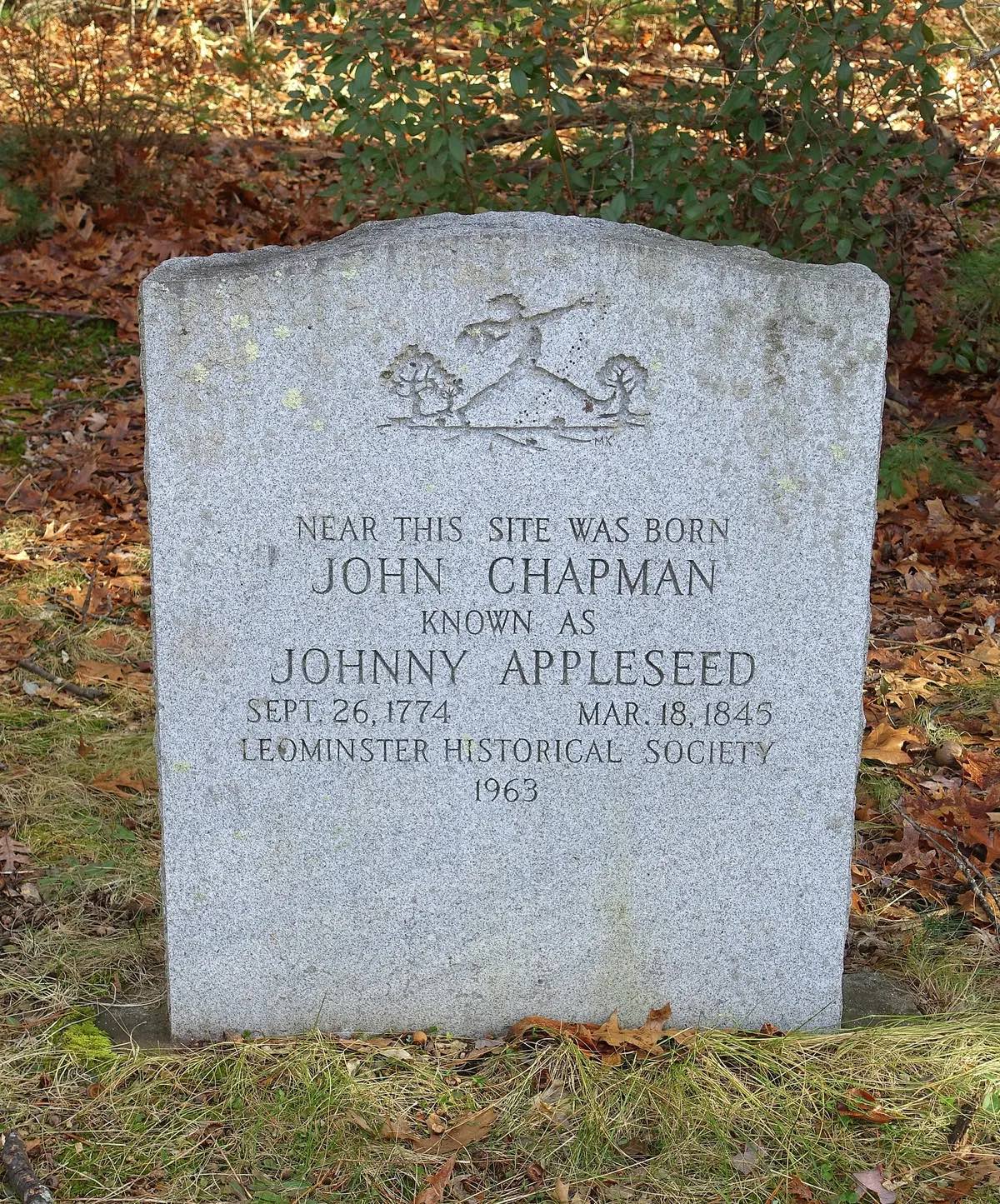
Located on Route 2, just west of Lancaster, Massachusetts, the Johnny Appleseed Visitors’ Center pays homage to one of America’s iconic folk legends. A larger-than-life frontiersman whose story has captured the imagination of countless generations, Appleseed was born John Chapman, just down the road in Leominster, on the cusp of the American Revolution in 1774. At 18 he headed west, apprenticed at an orchard, and began his life-long love affair with the apple—planting millions of trees and walking more than 4,000 miles in the process.
While the romanticized legend of Johnny Appleseed portrays him wandering haphazardly throughout the countryside barefoot (occasionally with a pot on his head) scattering apple seeds along the way, in truth he was a thoughtful and talented businessman whose relocation west was perfectly timed to take advantage of government policies encouraging permanent settlement. In the early 19th century, homesteaders, in what was then the wilderness, were granted 100 acres of land, and required to plant 50 apple trees and 20 peach trees in three years’ time.
Chapman, besotted with the apple, realized that he could do the hard work of establishing orchards, which he sold at a profit to incoming settlers, and nurseries, in which he maintained ownership, and move on, a pattern that established his reputation as a wandering purveyor of the fruit. As for the moniker “Appleseed”, Chapman, a devoted Swedenborgian, really did carry apple seeds with him from place to place in a sack, as his religious beliefs forbade grafting, believing it made the plant suffer.
Apples planted from seed are best suited for cider, which was the beverage of choice for Americans at the time. It was consumed freely and abundantly, providing a safe alternative to water which could be full of dangerous bacteria. According to Howard Means, author of Johnny Appleseed: The Man, the Myth, the American Story, life on the frontier was lived in an alcoholic haze with transplanted New Englanders on the frontier consuming 10.52 ounces of hard cider per day. Apple cider, “was as much a part of the dining table as meat or bread,” according to Means. Thus, Chapman had a robust market for his product.
While a successful ‘apple’ entrepreneur, Chapman was also a deeply spiritual man who eschewed the trappings of a conventional life. He traveled the countryside spreading both apple seeds and the tenants of his faith. He dressed shabbily, did not wear shoes and slept in the woods. He was passionate about the natural world and all the creatures in it and became a vegetarian in his later years. It is this caricature of him which has survived in the historical canon with the nickname Johnny Appleseed first appearing in an 1817 publication by the Church of New Jerusalem in England. The 1871 article, “Johnny Appleseed: Pioneer Hero” in Harper’s New Monthly Magazine by W.D. Haley cemented his identity as the “apple seed man” and made him a national icon. The Legend of Johnny Appleseed, an animated short musical segment from Walt Disney‘s 1948 film Melody Time, introduced Chapman to new audiences, making him a national caricature.
Chapman did not marry and upon his death willed his fortune to a sister which included a minimum of 1,200 acres of orchards. In keeping with his itinerant nature, Chapman did not maintain accurate records, and it is likely that his property holdings were much larger. Much of these were sold to pay back taxes and today the last apple tree planted by Chapman, of the Rambo variety and certified by the Johnny Appleseed Museum and American Forests, is located at the Alego Farm in the village of Savannah, Ohio.
Closer to home, the Johnny Appleseed Visitor Center features interpretive materials about Chapman and a bronze sculpture of him at its entrance. Ninety-one apple trees are located on the property, including three Rambo trees that are direct descendants of the last remaining tree known to be planted by Johnny Appleseed.
Image caption: Marker near the birthplace of John Chapman on Johnny Appleseed Lane in Leominster, MA. Credit: Daderot/Wikimedia Commons