
 FIRST CHURCH OF CHRIST, LANCASTER, MA
 BACK TO RESULTS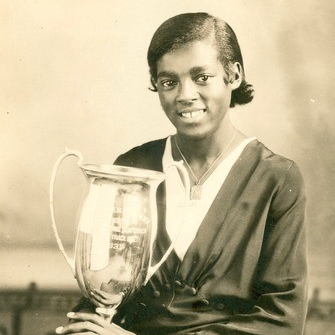
A talented athlete, Louise Stokes (1913-1978) loved to run from an early age. While a middle school student at Beebe Junior High School in Malden, Massachusetts, she joined the Onteora Track Club training under coach William H. Quaine, the city’s Park Commissioner. At Malden High School, Stokes continued to excel at track, earning the moniker, “The Malden Meteor.” In 1931 Stokes competed at the Mayor’s Day Track meet, setting a New England record of 12.6 seconds in the 100-meter dash and receiving the James Michael Curley Cup for outstanding women’s performance.
Stokes became a local phenomenon widely acknowledged in the press for her accomplishments. In 1932, at the age of 18, she was Invited to attend the Olympic Trials, where she earned a coveted spot as part of the women’s 4×100-meter relay pool for the 1932 Los Angeles Olympic Games.
Tidye Pickett, a runner from Chicago, also qualified for the relay pool and together they represented the first two Black women to qualify for any U.S. Olympic team. Despite their outstanding performances, neither competed in the 1932 Games, as four white women were selected for the final relay team.
In 1936 the Olympics were held in Berlin, Germany, and Stokes and Pickett were selected once again to represent the United States as members of the 4×100-meter relay team. The city of Malden rallied behind Stokes, raising funds for her to attend. For a second time, she and Pickett were replaced with white runners that were slower than they.
When Stokes returned to Malden from Berlin, she was greeted as a hometown hero. A two-time Olympian, she drew an estimated 58,000 well-wishers for a celebratory ticket-day parade—an Olympian’s welcome befitting her achievement. A feature in the September 11, 1936, edition of The Boston Globe titled “Malden Welcomes Louise Stokes Home,” recorded the “welcome-home reception” noting that, “although Miss Stokes was a member of the Olympic team, she did not compete in the relay race in Berlin.”
Upon her retirement from running, Stokes’s athletic accomplishments continued. She became a professional bowler, winning many titles. In 1941 she founded the Colored Women’s Bowling League.
Stokes is remembered today with a statue in her honor in the Malden High School courtyard. In 2020 the 3.2-mile Malden River Loop, which spans Malden, Everett, and Medford was dedicated to her, a fitting tribute to a runner who pursued her passion despite being discriminated against because of her race. A sign along the Loop reads: “Dedicated to Louise Stokes, Malden High, Track Star & 1st African American Woman U.S. Olympian 1936.”