
 FIRST CHURCH OF CHRIST, LANCASTER, MA
 BACK TO RESULTS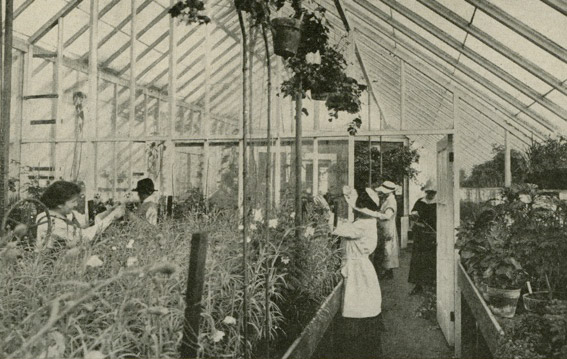
Freedom’s Way National Heritage Area is a “region of ‘firsts’ in American invention, thought, and design” celebrated for its role in fostering social, political, cultural and intellectual movements that provided new ways of looking at, and operating within, the world. And so, as we celebrate Women’s History Month, we take a “Closer Look” at the first school in the United States to train women in the practice of landscape architecture, founded in Groton, MA by Judith Eleanor Motley Low.
Created to provide women entrée into what was a new profession, landscape architecture, the school was founded in 1901, one year after Harvard University, which did not admit women, developed the first academic course on the topic. If women, whose purview in the gardening world was already well established, were to participate in this new profession they required similar training. And while little is known about Low’s personal impetus for establishing the Lowthorpe School, in many ways she was the ideal candidate to undertake such an endeavor.
The great-great granddaughter of Benjamin Bussey, Low spent her childhood at Woodland Hill in Jamaica Plain, MA which was endowed to Harvard University as a school of agriculture and horticulture in 1835 and is now part of the Arnold Arboretum. In an address she gave before The Garden Club of Alameda County on June 11, 1922, titled “The Founding of the Tree Museum in Bussey Park,” Low recalled her time here, where the site’s 360 acres had been laid out in 1815 by an architect with “great artistic taste.” She provides a detailed account of the undulating landscape, magnificent vistas and picturesque grounds that contained both cultivated gardens and woods filled with wildflowers, noting that “the wonderous Hemlock Hill” which you can visit today, was designated by Sir Joseph Hooker of Kew Gardens, England “the finest in the world.”
Most importantly, Low’s father, Thomas Motley, Jr., taught at The Bussey Institute (1883 to 1936) the only Harvard institution to include female students. As cited in the Annual Reports of the President and Treasurer of Harvard College: 1897 – 1898, “A demand having arisen for the admission of a few women to Mr. Watson’s course on landscape gardening, the Corporation granted the application on the ground that a knowledge of horticulture and landscape architecture might open to women a field in which they could win success.” Thus, not only did Low grow up acquainted with plants and trees and all that goes to make a beautiful garden, according to Lowthorpe School principal, Mrs. Cyrus Winslow Merrell, she had the “inherited taste and education and was fitted to make a scholarly venture into a new field. It was her desire to open the way for women to a new profession…”.
From its inception, the Lowthorpe School positioned itself as a laboratory for learning with a robust curriculum designed to fully equip its female students to practice as landscape architects. Sited on a historic property, the former Prescott House, the school boasted a 16-acre campus of meadows, orchards, gardens and greenhouses, a large library and reading room, conservatory, zoned greenhouse, grapery, azalea pit and toolsheds. The grounds were used actively with students designing and maintaining gardens, water features and hardscapes. The combination of hands-on learning combined with classroom study, augmented by off campus enrichment activities was unique for the time and differed from the classical approach to landscape architectural study offered by all-male institutions.
In operation from 1901 to 1945, the school evolved academically attracting well-known landscape architecture practitioners, such as Fletcher Steele who served on the school’s Education Committee, as instructors, lecturers and design critics. It maintained close ties with Harvard University’s landscape architecture program. By 1909 the school was fully incorporated and by 1915 the curriculum expanded from two to three years with diplomas awarded. Reflecting these changes, on its 1924–1925 catalogue it was described as “Lowthorpe – A School of Landscape Architecture for Women.”
The school graduated many pioneering female landscape architects, including many of whom went on to develop independent practices throughout the United States with thirteen alumni recognized by the Cultural Landscape Foundation as “Pioneers in Landscape Architecture.” Attesting to the high caliber of the school’s students, Ellen Biddle Shipman, a nationally renowned landscape architect who created more than 650 gardens and was at the forefront of landscape design in the United States, staffed her all-female office with Lowthorpe graduates.
Despite its success and depth of emotional support, over time the school’s location, lack of professional accreditation to formally grant a degree, changing opportunities for women to study elsewhere, and lack of financial security made it difficult to continue the program. In 1945 the school moved to Providence, Rhode Island and became the Lowthorpe School of Landscape Architecture with the Rhode Island School of Design, a co-educational independent school.
Today, according to the abstract “Status of Women in Landscape Architecture” published in the May 2024 issue of the Landscape Journal, while there is a “significant female presence in landscape architecture education programs across the United States, women lag behind in career achievements such as awards, fellowships, and leadership positions.” Statistics provided by Data USA further indicate that despite 66% of graduate students in the profession identifying as female, 27% of licensed landscape architects are women, 12% occupy advanced leadership positions and only 25% of American Society of Landscape Architects professional honors have been awarded to women.
Image: The Lowthorpe Greenhouse. House Beautiful magazine. March 1916, Vol. 39 No. 4, pg. 111. Courtesy of Priscilla Hutt Williams