
 FIRST CHURCH OF CHRIST, LANCASTER, MA
 BACK TO RESULTS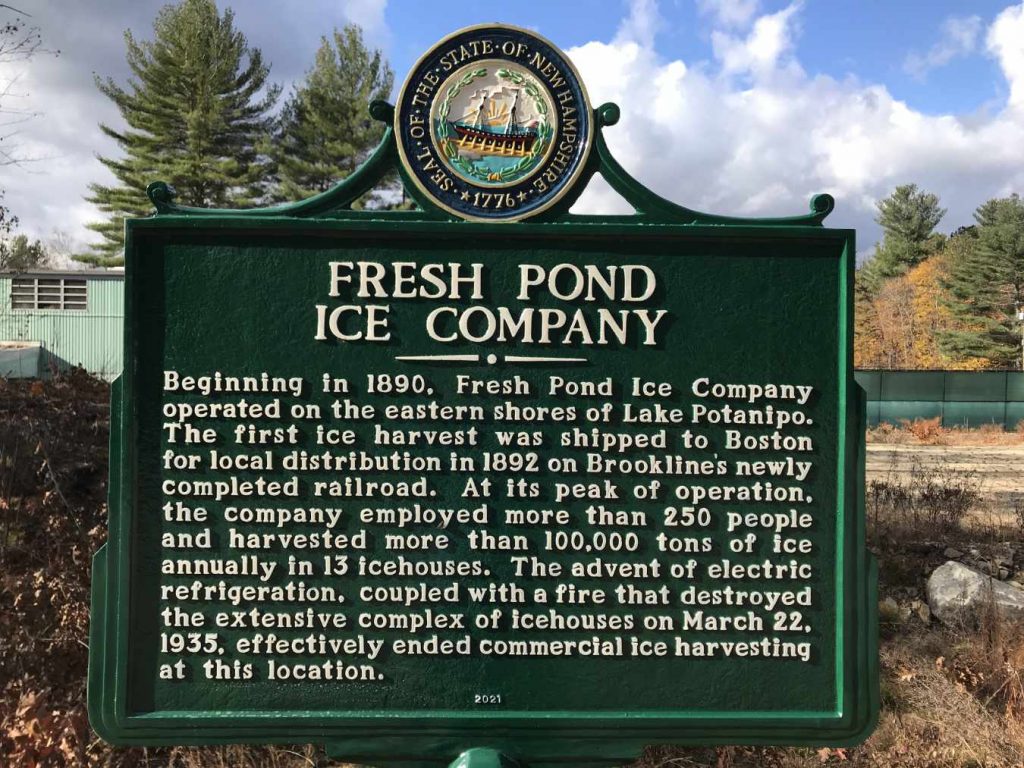
Before modern refrigeration, natural ice was one of New England’s most important commodities. Between the early 19th century and the advent of electric refrigeration in the early 20th century, cutting and storing ice from frozen ponds and lakes supplied urban households, businesses and even foreign markets with a vital preservative and cooling resource. The industry shaped local economies, transportation networks and labor patterns throughout the region, including within what is now the Freedom’s Way National Heritage Area.
Commercial ice harvesting in New England began in earnest in the early 1800s, driven by Boston merchant Frederic Tudor, who earned the nickname the “Ice King.” Tudor recognized ice as a commodity that could be shipped from the region’s abundant bodies of cold water to distant markets. His operations began at Fresh Pond in Cambridge, MA in 1805 and expanded rapidly with innovations in cutting tools and storage techniques. By the 1840s, Tudor was harvesting ice from across eastern Massachusetts including Spy Pond in Arlington, Sandy Pond in Ayer, Walden Pond in Concord and Horn Pond in Woburn.
During the winter of 1846/47, Henry David Thoreau—who had recently moved to the shores of Walden Pond to immerse himself in nature’s tranquility —observed workers from the Tudor Ice Company over a period of sixteen days. In Walden he wrote, 100 Irishmen “came from Cambridge every day to get out the ice,” bringing with them, “many carloads of ungainly-looking farming tools—sleds, plows, drill-barrows, turf-knives, spades, saws, rakes.” His peace disturbed, Thoreau grumbled, “Thus it appears that the sweltering inhabitants of Charleston and New Orleans, of Madras and Bombay and Calcutta, drink at my well.” That year alone, 353 ice-packed vessels left Boston Harbor for points south and abroad carrying nearly 75,000 tons of ice. An estimated 27,000 additional tons were used locally.
Ice harvesting was intensely seasonal and labor-intensive. Workers waited until mid-winter when ice reached a sufficient thickness—often 12–18 inches or more—to begin cutting. Snow was cleared, grids were scored with horse-drawn tools or plows, and blocks were cut with long saws. Once cut, ice was floated downstream, loaded onto ships or railcars and insulated for transport or, if staying local, guided to shore, hoisted into storage barns known as “icehouses,” and packed with straw or sawdust (for insulation) to preserve it through the summer.
Ice harvesting also played a significant role in Brookline, NH’s history, most notably through the operations of Thomas S. Hittinger’s Fresh Pond Ice Company on the eastern shores of Lake Potanipo. In 1890, the company relocated from Cambridge, drawn by the lake’s size, water quality, and proximity to the newly built Brookline Railroad. At its peak, the company employed more than 250 workers and maintained thirteen massive icehouses capable of storing over 100,000 tons of ice. The industry brought seasonal economic vitality to the town until the rise of mechanical refrigeration and a devastating fire at the complex in 1935 hastened its decline. In 2021, the 271st New Hampshire Historical Highway Marker was installed along Route 13 in Brookline, marking the former site of the Fresh Pond Ice Company’s operations.
By the early 20th century, mechanical ice production and electric refrigeration began to replace natural ice harvesting. Markets shifted, icehouses closed, and the labor-intensive trade largely faded by the 1930s. Nevertheless, the cultural memory of ice harvesting persists in local historical societies and annual winter demonstrations. Within the Freedom’s Way region, ice harvesting remains part of the local narrative: a reminder of how rural and small-town communities contributed to regional industries that once reached global markets. Numerous ice houses within the Heritage Area have been preserved and are viewable by the public. Notable examples include the c. 1900-1905 Richardson farm icehouse in Boxborough, MA which was relocated to the town-owned Steele Farm property, restored and protected in perpetuity with a preservation restriction, and the three-story icehouse near Josephine’s Pond at The Wayside Inn in Sudbury, MA which served the inn when Henry Ford owned the property in the 1930s.
The history of ice harvesting in New England exemplifies how a seemingly simple natural resource became the basis for a complex economic network, integrating rural lakes and ponds with rails, ports, and distant markets. Within the Heritage Area’s 45 communities, this history surfaces through local ponds such as Walden Pond, Lake Potanipo and others. Today, these stories add depth to the region’s rich heritage, connecting Revolutionary history with industrial innovation.
Sources:
https://www.bu.edu/articles/2022/tracing-the-history-of-new-england-ice-trade/
https://brooklinehistory.org/historical-marker-ice-harvesting/
https://historycambridge.org/innovation/Ice.html
https://www.nps.gov/articles/000/fresh-pond-ice-company-sign.htm
https://www.discoverconcordma.com/articles/299-the-old-hag-the-ice-king-and-the-artichoke-concords-role-in-the-insane-ice-trade
https://wlfarm.org/ice-harvesting/
https://drive.google.com/file/d/1CVGR5hq5vPeP3-lsrXH73gIDm44vD0Gr/view
Image courtesy of the Brookline Historical Society