
 FIRST CHURCH OF CHRIST, LANCASTER, MA
 BACK TO RESULTS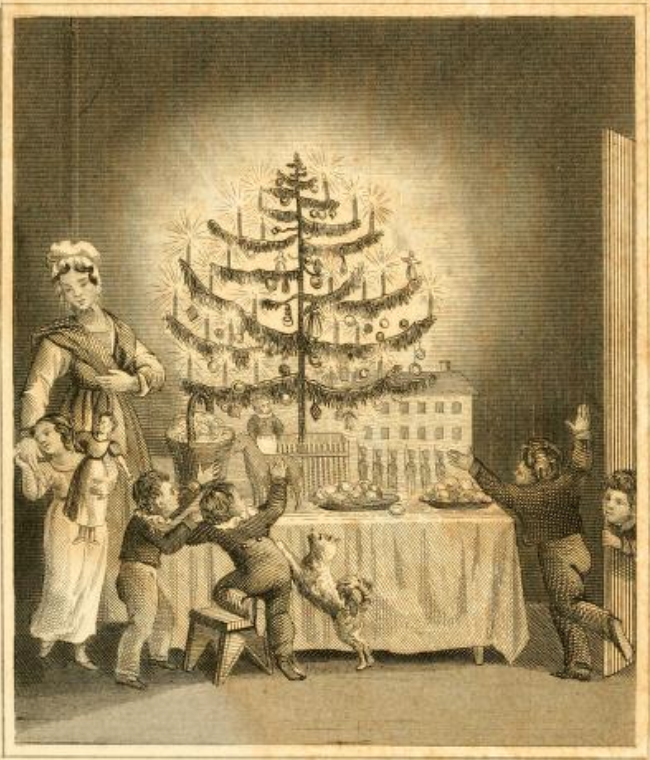
In colonial Massachusetts and New Hampshire, Christmas passed much like any other winter’s day. The region’s Puritan settlers viewed the holiday as non-biblical and even sinful, so much so that from 1659 to 1681, the Massachusetts Bay Colony banned Christmas observances, fining anyone who celebrated.
For generations, New Englanders knew no festive carols, decorated homes or even evergreen trees trimmed for the season. Yet, in time, newcomers and new ideas would take root, and the quiet, solemn colonies would become the unlikely stage for one of America’s earliest Christmas tree traditions.
It began slowly, carried across the Atlantic not by English colonists but by German immigrants who cherished the custom of decorating a fir tree with candles, sweets, and paper ornaments. In cities like Boston and Cambridge, these newcomers found themselves in a land where midwinter celebrations were still unusual, but curiosity had begun to thaw old attitudes. By the 1820s and 1830s, Christmas was appearing on private calendars, if not yet on public ones. And into this shifting cultural moment stepped a young German academic named Charles Follen.
Follen arrived in New York City in 1824, at the age of 27, with a scholar’s mind and an exile’s longing for home. A political radical in Europe, he had fled to America seeking opportunity and intellectual freedom. Follen spent his first year in America finishing his studies of the English language and law in Philadelphia, and in November 1825 accepted an offer from Harvard University and became its first German professor. But as December approached, he found himself missing the cheerful glow of a candlelit tree—a symbol of warmth and promise during the darkest days of the year.
Now settled in Cambridge with a growing family, Follen decided to recreate the tradition for his young son, not knowing he would be planting a seed that would spread far beyond his parlor walls. One snowy afternoon in December 1832, Follen carried a small evergreen into his home. He and his wife Eliza (née Cabot) trimmed it with small dolls, gilded eggshells, paper cornucopias filled with candied fruit, and tiny candles set carefully in metal holders.
Harriet Martineau, an English journalist visiting Boston at the time, describes the tree’s unveiling at the Follens’ Christmas party: “It really looked beautiful; the room seemed in a blaze, and the ornaments were so well hung on that no accident happened, except that one doll’s petticoat caught fire. There was a sponge tied to the end of a stick to put out any supernumerary blaze, and no harm ensued. I mounted the steps behind the tree to see the effect of opening the doors. It was delightful. The children poured in, but in a moment every voice was hushed. Their faces were upturned to the blaze, all eyes wide open, all lips parted, all steps arrested.”
Word of this magical sight traveled quickly. The following year, Follen offered to display the tree at a holiday gathering, and his friend Lydia Maria Child of nearby Medford wrote about it in the Juvenile Miscellany, bringing the idea to households across New England. What had been a private gesture of homesickness became a public celebration, and the Christmas tree began its slow but steady rise in American life.
Within a few years, Follen’s revolutionary spirit once again altered his life’s trajectory. He lost his professorship due to his outspoken abolitionist beliefs and conflict with the University President’s strict disciplinary measures for undergraduates. He joined the Unitarian Church and was ordained as a minister in 1836. After preaching in a number of congregations, Follen returned to East Lexington in 1839 and designed a unique octagonal meeting house, for which ground was broken on July 4, 1839. In his prayer at the groundbreaking, Follen declared the mission of his church:
[May] this church never be desecrated by intolerance, or bigotry, or party spirit; more especially its doors might never be closed against any one, who would plead in it the cause of oppressed humanity; within its walls all unjust and cruel distinctions might cease, and [there] all men might meet as brethren.
The following year, Follen was enroute from New York City to Boston to attend the dedication for his new church aboard the Steamship Lexington which caught fire and sank in Long Island Sound. He died at the age of 43. Today, Reverend Charles Follen’s octagonal church still stands in East Lexington.
A memorial to his legacy is placed in the churchyard. Its inscription reads:
CHARLES FOLLEN
BORN IN HESSE-DARMSTADT
SEPTEMBER 4 1796
A FEARLESS ADVOCATE
OF LIBERTY AND JUSTICE
EXILED FOR CONSCIENCE SAKE
HE SOUGHT IN AMERICA THE FREEDOM
DENIED HIM IN THE OLD WORD
DISTINGUISHED
FOR RICH AND VARIED LEARNING
FOR UNCOMPROMISING DEVOTION TO
THE CAUSE OF THE OPRESSED
AND ENSLAVED AND FOR THE SIMPLICITY
AND INTEGRITY OF HIS CHARACTER
HE ORGANIZED IN THIS TOWN
THE FREE CHRISTIAN CHURCH
AND BECAME ITS FIRST PASTOR
DESIGNED THE OCTAGON MEETING HOUSE
HERE ERECTED AND ON HIS WAY TO
ITS DEDICATION WAS LOST IN THE
BURNING OF THE STEAMBOAT
“LEXINGTON”
ON LONG ISLAND SOUND
JANUARY 13 1840
—
THIS TABLET ERECTED
1915
Image: It is believed this image, titled “Christmas Eve,” from the 1836 book The Stranger’s Gift by Harvard University instructor and German scholar Hermann Bokum is likely the first image of a Christmas tree published in America.